


The DfE is developing a clearer picture of the nation's school buildings..

How clear is the picture held by the people responsible for them?
Could the future of school capital funding be decided by the quality of our estate data, long before anyone makes a compelling case for investment?
Imagine asking three people in the same school or academy trust a simple question:
"What are our three biggest estate risks over the next five years?"
The Headteacher might talk about disruption to education.
The CFO might identify future financial liabilities.
The Estates Manager will probably be concerned about ageing heating systems, electrical infrastructure or deteriorating building fabric.
Three knowledgeable people. Three perfectly reasonable answers.
But what would the trustees say?
More importantly, what evidence would they have to support their answer?
I think this question is becoming considerably more important than many of us probably realise at this stage..
Is the DfE changing the rules of the game?
The Department for Education's February 2026 Education Estates Strategy: A Decade of National Renewal signals something rather significant when I read it.
Naturally, much of the discussion revolves around capital investment, rebuilding programmes and funding.
But buried within the strategy is something potentially more consequential.
Hunger for data. Lots of it…
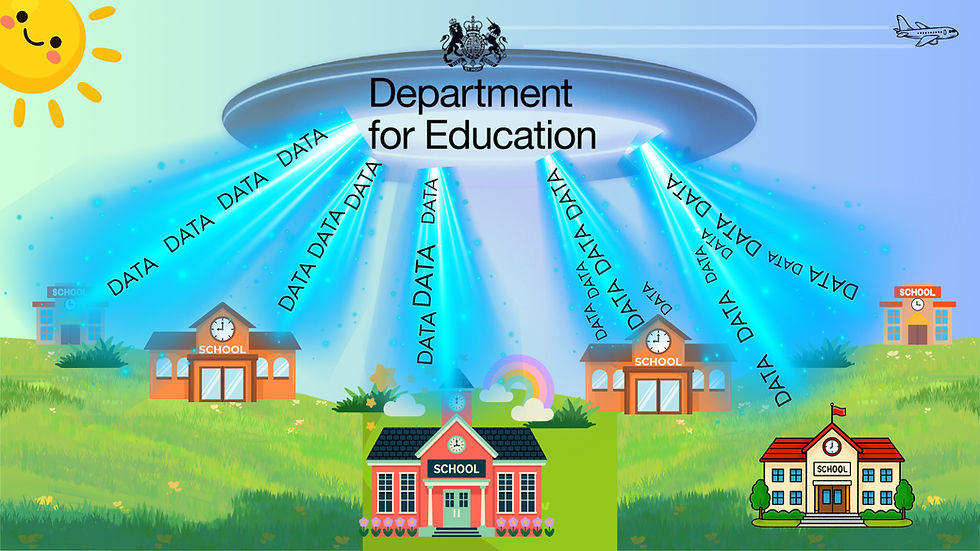
Collected consistently, connected nationally and increasingly used to inform decisions about where money goes.
Consider the direction of travel:
The new School Estate Management Standards annual return began in September 2026.
The DfE published its common Education Estates Property Data Model in August.
Pilots for standardised estate data collection are taking place during 2026-27, with national rollout planned from autumn 2027.
Two-way estate data sharing is planned by 2028.
The ambition is comprehensive responsible-body data coverage by 2029-30.
And here's where it gets particularly interesting.
The strategy explicitly refers to predictive analytics and testing the potential of artificial intelligence.
It also proposes replacing the Condition Improvement Fund by autumn 2028 with a funding approach supported by more timely, granular estate data, removing the requirement for full bids.
Consider the implications of that for a moment… with me?
What if your next funding application consists of only your estate data?
Historically, obtaining capital investment has involved assembling evidence, writing a compelling needs case and demonstrating the consequences of deteriorating assets/buildings.
The DfE is now seemingly developing the ability to identify and compare some of those needs directly.
We can already see this approach in action. The new £710 million Renewal and Retrofit Programme addresses the liminal between conventional maintenance and major rebuilding.
Its initial phase selects schools according to condition need, through a DfE-led process rather than competitive applications.
Meanwhile, the School Rebuilding Programme continues the rebuilding work undertaken through earlier programmes, including the Priority School Building Programme.
Different programmes, but an emerging common theme:
Increasingly, the evidence may be doing the asking.
Prediction 1.
Now, here's my philosophical leap.
I suspect that over the next few years,
AI and predictive analytics will become increasingly involved in how the DfE analyses the national estate and informs investment priorities.
Imagine combining building condition, age, maintenance history, structural risk, energy performance, occupancy, climate exposure and future student demand.
Across (tens of) thousands of schools.
The potential to identify patterns, forecast deterioration and compare investment scenarios is massive.
And the DfE has already begun putting the data structures in place to make that possible.
To be clear, the strategy establishes the foundations and explicitly discusses testing AI. The extent to which AI will ultimately influence individual funding decisions remains to be determined, obviously, this is me speculating.
But this idea certainly gives us something to think about.
The evidence behind that possibility - an analysts mosaic

Is it more than an interesting technological theory? I did some digging to find where the ideas underpinning this approach may have come from originally.
A 2024 review by Anthony Scaife, published in Results in Engineering, examined the application of AI to predictive maintenance in facilities management. One particularly revealing finding was that insufficient data represented a major barrier to successful AI implementation. Fairly obvious, but what else?
A 2025 systematic review in Buildings, examining 105 academic papers, found that AI combined with digital twins and real-time asset data could help identify deterioration earlier and support predictive maintenance. Bingo! In a practical demonstration, researchers achieved 65-80% accuracy in identifying road-surface defects using AI.
Perhaps more interestingly, the research highlighted how far building and infrastructure management still has to go in adopting these technologies.
Think what that could mean when applied to (tens of) thousands of school buildings, using consistent condition, asset and maintenance data.
The potential to anticipate deterioration and to direct suitable investment before failures occur is massive, and to me, that makes the DfE's current drive towards standardised estate information particularly interesting..

And last but not least, the above - the National Audit Office, in its 2023 report on the condition of school buildings, argued for better use of DfE condition information to target available resources and achieve longer-term value.
Put all those findings alongside the DfE's new Property Data Model and a rather interesting paradigm begins to emerge..
Collect consistent estate data, connect it through Building Information Modelling (BIM) and, eventually, digital twins of a school's vital assets, and suddenly we're looking at something far more powerful than another collection of spreadsheets or Microsoft Lists tapping Power Bi.
We're potentially laying the foundations for a seismic shift in how school estates are funded - moving from reactive (mirroring the maintenance) spending, to proactive (more mirroring of the maintenance) investment, and ultimately towards predictive (maintenance and investment) ie where and when funding will actually be needed.
Introducing AI into the equation, analysing condition, performance, deterioration and risk across tens of thousands of schools simultaneously.. (I know what some have already been saying about the potential to dupe this type of system, why don’t we just report that our school is knackered? Why don’t we overstate issues? Then we’ll get more money? I am sure there are suitable safeguards in place for this, but I will dig into them somewhere else, other than here - this particular article is an overview in good faith, so I shall continue along those lines for now).
You can see where this could all be heading, can't you?
Imagine the funding system where the evidence makes the case for investment before the building makes the case through actual failure.
That's quite a jump in thinking and expected performance for Schools, Heads, CFO’s, Site staff and Trustees. And, to my ageing mind, one of the most interesting possibilities emerging from the Education Estates Strategy's supposed direction.
Of course, algorithms are only as useful as the information and assumptions supporting them. A national model must also account for local circumstances, educational suitability and the real consequences of failure.
A heating system serving specialist Alternate Provision, for example, may carry consequences that a simple condition rating struggles to express clearly, especially on a cold January morning at half six.
That is precisely why local estate understanding remains so important - and we should err on the side of caution that the Robots and Synthetic microchip brains will quickly eradicate jobs, performance and human thinking processes. At least for now.
Here's the paradox
As the DfE becomes better informed about the national education estate, an individual Trust could still remain dependent on fragmented information. Most schools as we know already hold extraordinary quantities of estate data. Condition surveys. Compliance certificates. Asset registers. Contractor reports. Maintenance records. Capital plans etc.. etc..
Somewhere, somebody probably knows which valve isolates the heating to the science block. The question is whether that knowledge is accessible, connected and meaningful to the organisation.
A building can be compliant and functional today and represent a substantial financial liability tomorrow. A maintenance budget can be balanced all the while entropy and deterioration inevitably continues. A seemingly perfectly reasonable decision to defer a repair can quickly become next week/month/year's expensive emergency - there are so many variables..
A governing board can receive regular estate reports while realistically having only a partial or misrepresented understanding of its actual true position.
Having information and understanding what it means are two very different things.
There is another somewhat intriguing possibility...
In a more data-led funding environment, the quality of an organisation's estate information may influence how accurately its needs are represented. A deteriorating asset that is poorly recorded could be harder to recognise within a national dataset.
That creates an interesting inversion:
The information you hold about your buildings could become almost as important and valuable to future investment decisions as the actual buildings themselves!
Estate Literacy - a different way to think about governance
I often (perhaps over) use the term Estate Literacy.
By this I mean;
an organisation's ability to understand its estate information, recognise developing risks and use that knowledge to make informed decisions.
For governors and trustees, I hope this will raise some (fairly obvious) questions:
Where do we actually stand against the DfE's estate management standards?
Which buildings or assets represent our greatest emerging liabilities?
What are our priorities over the next one, three and five years?
Which risks are we consciously carrying forward?
How much of our essential estate knowledge depends on one or two individuals?
And perhaps, given the direction of the Education Estates Strategy:
If the DfE were to build a MODEL of our estate using the information available to it, would that picture accurately reflect what we ourselves know locally?
Now that's an interesting question for boards and SLT alike.
Because the ability to demonstrate a defensible position is increasingly valuable in a system moving towards common data, national comparison and evidence-led investment.
Knowing where you stand changes what you know
There is something deceptively powerful about establishing a clear starting position.
Imagine a Gov’s/Trust board receiving a concise, independent picture of its estate. Current strengths, areas requiring attention, GEMS alignment, any emerging liabilities, operational dependencies, priorities for improvement so on so forth.. In short order, maintenance becomes a discussion about strategic choices.
Capital expenditure needs consideration alongside future consequences. Gov’s/Trustees can understand why one investment deserves attention ahead of another. And we, the people responsible for the estate, can explain the reasoning behind decisions with considerably greater confidence.
I find this a useful reframe:
The real value in an estate condition assessment may actually be the decision it helps you make correctly three or four years later.
That is an interesting return on something as straightforward as understanding where you currently stand. Right?
One question for your next meeting cycles?
Here's a small, quick experiment.
Ask your Headteacher, CEO, CFO and Estates/Site Director/Manager independently to;
identify the three most significant estate risks facing your establishment over the next five years.
Then compare their answers...
The differences between the answers may reveal more about your organisational Estate Literacy than another lengthy committee report.
Consider those answers alongside the DfE's School Estate Management Standards and the direction established by the Education Estates Strategy.
Do they describe a consistent, evidence-based picture?
After more than 20 years working in school estates, I increasingly believe that the next significant improvement in our sector will come from combining practical estates knowledge with better information and this will lead to better decisions.
The DfE is developing the capability to understand our national estate in unprecedented detail.
With AI and predictive analytics potentially accelerating that understanding, the coming years could fundamentally change how we identify, prioritise and fund improvements.
Which leaves governors and trustees with one rather important question...
If the DfE is getting ready to understand your estate in extraordinary detail, shouldn't you know exactly where you stand first?
#EducationEstatesStrategy #SchoolEstates #EstateLiteracy #SchoolGovernance #EducationLeadership #AIinEducation


Comments